
What Is a Brand Audit? The 60-Minute Check Most B2B Companies Skip
Published by Quincy Samycia · · 6 min read

What Is a Brand Audit? The 60-Minute Check Most B2B Companies Skip
Ask three people on your team to describe what your company does. You'll get three different answers. Now compare your homepage headline to your last sales deck and your LinkedIn company page. Three more.
That gap — between what you think your brand says and what it actually says — is where deals quietly die. A brand audit is how you find it, measure it and fix it.
What a brand audit actually is
A brand audit is a structured, evidence-based review of every public signal your company sends: your website copy, messaging, positioning, visual identity, and how consistently all of it shows up across channels.
It is not an SEO audit. It is not a design critique. It answers a harder question: when a buyer, an investor or an AI search engine encounters your brand, do they get one clear, credible, consistent story — or a different one every time?
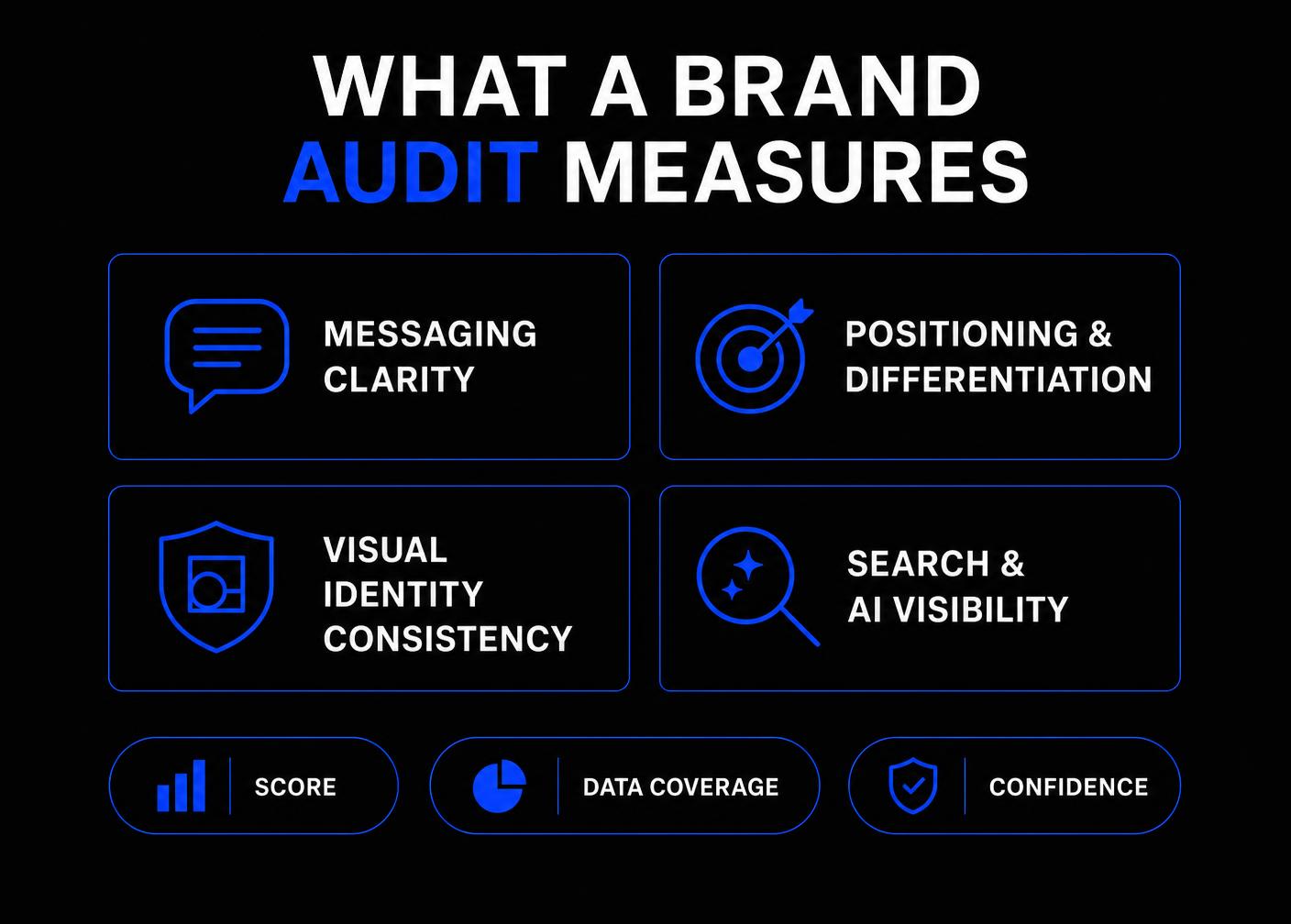
A proper brand audit measures things like:
- Core messaging — is there a clear value proposition, and does it survive past the hero section?
- Brand story, vision and mission — present, differentiated, or generic filler?
- Voice and tone — does the copy sound like one company, or five different writers?
- Positioning — are you clearly for someone, against something, or politely forgettable?
- Visual identity and creative consistency — logo usage, colour, typography, imagery across every touchpoint.
- Supporting proof — case studies, claims, and evidence that back the story up.
| Brand audit pillar | What it evaluates | Common failure signal |
|---|---|---|
| Core messaging | Value proposition clarity and retention past the hero | Value proposition disappears below the fold; generic claims |
| Story & mission | Differentiation, purpose, and narrative substance | Unsubstantiated filler; indistinguishable from competitors |
| Voice & tone | Editorial consistency across touchpoints and pages | Tone shifts noticeably between founder copy and contractor pages |
| Positioning | Specificity of target audience and competitive stance | Vague, all-things-to-everyone statements |
| Visual identity | Design system alignment (typography, colour, logo usage) | Inconsistent assets across decks, social profiles, and site |
| Supporting proof | Credibility signals, customer proof, and verified claims | Unsubstantiated assertions without case studies or evidence |
Why most B2B brands fail it
Not because their teams are bad. Because brands drift. A homepage written by a founder two years ago. A services page written by a contractor. Social posts written by whoever had time that week. Each piece is defensible on its own. Together, they contradict each other. Creating helpful, reliable, people-first content requires unified editorial standards and substantiated claims across every page.
The symptoms are familiar:
- Sales keeps re-explaining what marketing already "said."
- Prospects arrive on calls with the wrong idea of what you do.
- Your win rates are fine when you're in the room — and weak when you're not.
The brand isn't a coat of paint. It's the operating system every touchpoint runs on. When the OS has bugs, everything running on it glitches.
The new reason this matters: AI search
There's a second audience reading your brand now, and it doesn't skim — it summarizes. AI assistants and generative search engines synthesize your site, your reviews, your listings and your social presence into a single answer when someone asks about your category. Systems conducting web search in the OpenAI platform retrieve and synthesize multiple external web sources to formulate responses.
If your signals are inconsistent, the model's answer is inconsistent. If your story is thin, the answer is thin. This is exactly what an AEO audit and a GEO audit measure — and both start where a brand audit starts: with what your brand is actually saying. We covered the strategy side of this in Brand Strategy Is Now Your AEO and GEO Strategy.
How a brand audit works, step by step
- Collect the signals. Crawl the website, scan public profiles and listings, gather brand assets.
- Extract the claims. What does the brand actually say its promise, audience and difference are?
- Score the consistency. Compare messaging, voice and visual identity across every source, category by category.
- Find the gaps. Where the story breaks down, where proof is missing, where channels contradict each other.
- Prioritize the fixes. Ranked recommendations, from quick copy edits to strategic repositioning.
What you should walk away with
A brand audit that ends in a mood board is a waste of money. You should walk away with a scored diagnostic: what's working, what's broken, what it's costing you, and a prioritized plan to fix it — whether you fix it with your own team, with AI-assisted rewriting, or with an agency.
If you want to know where your brand stands before your next prospect asks an AI instead of asking you, run the Brand Health Audit. It takes about a minute to start, and the truth is usually cheaper than the guess.
Frequently asked questions
What is a brand audit in simple terms?
A brand audit is a health check for how your company presents itself. It reviews your messaging, story, positioning, voice and visual identity across every public touchpoint, then scores what's consistent, what's broken and what to fix first.
How is a brand audit different from an SEO audit?
An SEO audit measures how search engines find your pages. A brand audit measures what those pages say once someone — or an AI — reads them. SEO gets you found; brand consistency gets you believed and chosen.
How often should you do a brand audit?
At minimum once a year, and any time something significant changes: a new offer, a new market, a rebrand, a merger, or a shift in your ideal customer. Brands drift quietly — the audit is how you catch it before your pipeline does.
Can you do a brand audit yourself?
You can run a basic version: pull your homepage, sales deck, LinkedIn page and top three competitor sites into one document and look for contradictions. The hard part is objectivity — internal teams read what they meant to write, not what's on the page. That's why structured, external audits exist.
What does a brand audit include?
A thorough audit covers core messaging, brand story, vision and mission, positioning, audience definition, voice and tone, supporting proof, and visual identity consistency — each scored separately so you can see exactly where the brand breaks down.
How long does a brand audit take?
An automated diagnostic like the Brand Health Audit produces a scored report in minutes. A full agency-led audit with interviews and competitive analysis typically takes two to four weeks. The right depth depends on whether you're validating a hunch or rebuilding the brand.
Sources
- Creating helpful, reliable, people-first content — Google Search Central. Guidance on producing substantive, consistent, and reliable web content for audiences.
- Web search in the OpenAI platform — OpenAI. Documentation on how AI systems crawl and retrieve live web data to synthesize direct answers.
- Intro to structured data markup — Google Search Central. Explains how structured technical data provides explicit clues about web page entities and meaning.
Where this shows up in your audit
These scored categories cover what this article talks about.
Industry brand audits
Marketing & creative agencies brand audit · Moving & storage companies brand audit · Cybersecurity companies brand audit
Want this handled for you?
Positioning, messaging and brand story work, handled end to end.
Branding at The Branded AgencyGoing deeper on the strategy behind it: The framework the audit's brand strategy checks are drawn from. The Golden Spiral™ methodology.
Measured against real data
Every figure we publish comes from completed audits, reported as anonymised averages.
Related articles
- Where Brand Clarity Breaks Down Between Site and Sales Call
Discover why B2B brand clarity collapses between website visits and discovery calls, and learn how to audit and fix message drop-off across your sales journey.
- How to Measure Brand Differentiation Without Vanity Metrics
Learn how to measure brand differentiation in B2B using diagnostic health metrics like pricing power and message recall rather than misleading vanity metrics.
- Early Warning Signs of Brand Decay Before Revenue Drops
Revenue is a lagging metric. Learn the 5 leading indicators of brand decay—from margin compression to sales cycle drift—and how to diagnose brand health early.
Stay sharp
Get the next brand breakdown in your inbox
Practical brand strategy, messaging and AI-search insights. No fluff, no daily sends — just the work that moves brands.
Written by
Quincy Samycia
Founder & Brand Strategist, The Branded Agency
Quincy leads brand strategy at The Branded Agency, where he has spent over a decade helping founders and B2B teams sharpen their positioning, messaging and creative systems so growth stops depending on guesswork.
More from Quincy Samycia →See where your brand actually stands
Run the Brand Health Audit and get a scored diagnostic of your messaging, positioning and visibility.
Brand Audit