
Brand Strategy Is Now Your AEO and GEO Strategy
Published by Quincy Samycia · · 5 min read

Most brands do not have a visibility problem. They have a clarity problem that only looks like a visibility problem once buyers — and now AI answer engines — stop repeating them correctly.
That distinction matters more in 2026 than it did in 2020. Buyers no longer arrive at your homepage first. They arrive after ChatGPT, Perplexity, Gemini or Google's AI Overviews have already summarised who you are. If your brand strategy is vague, inconsistent or spread across six pages that each say something slightly different, the machine writes its own version of you. And that version is the one your buyer reads.
Answer engines quote strategy, not slogans
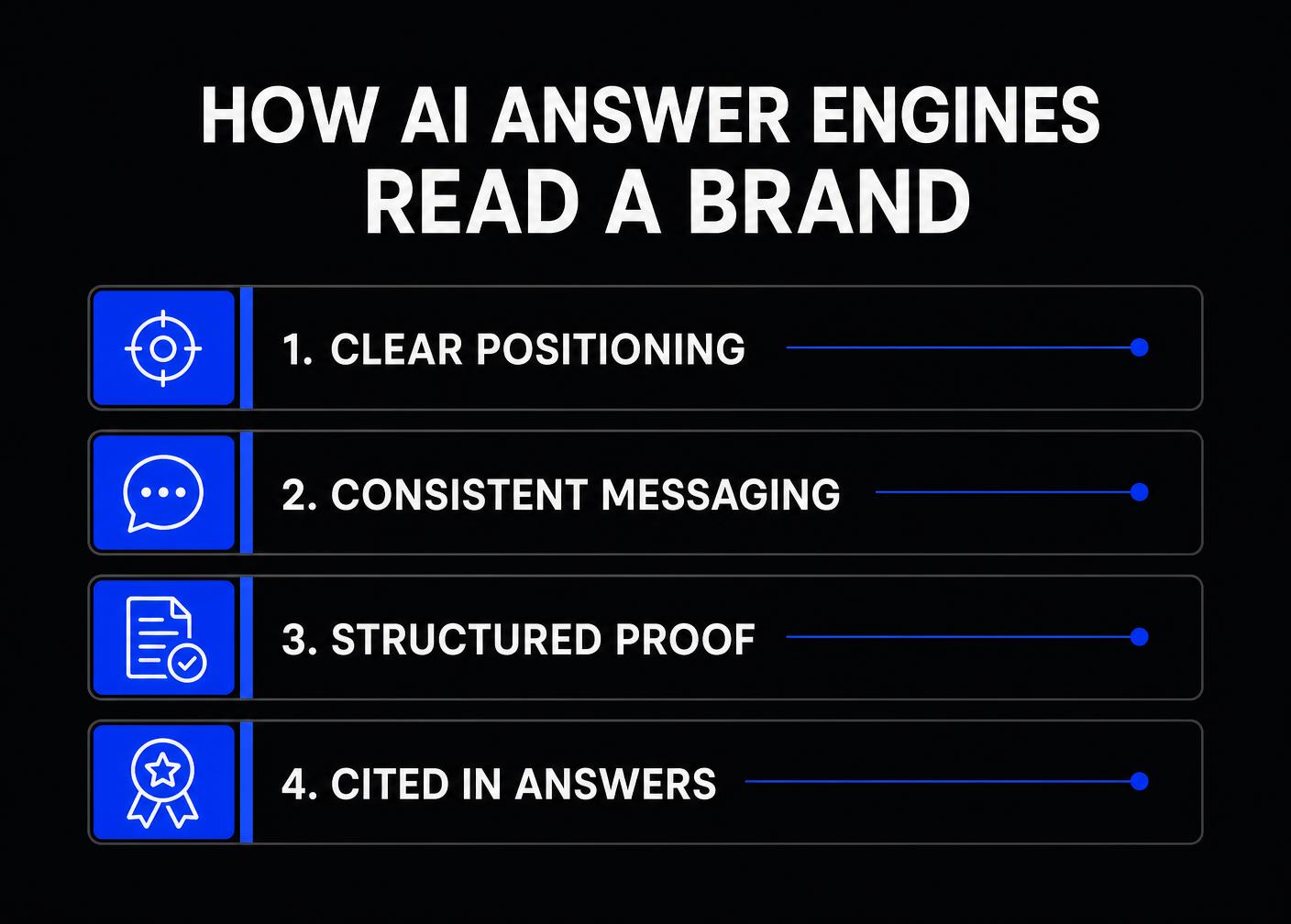
An AI answer engine has one job: produce a confident, sourced answer. To do that it looks for statements it can repeat safely — a plain description of what you do, who it's for, what makes it different, and proof that it works.
That is brand strategy. Positioning, key messages, supporting messages, and proof points are exactly the raw material these systems reward. Clever taglines are not. If your site leads with "Reimagining what's possible" and never states the category you compete in, there is nothing quotable, so you get skipped in favour of a competitor who wrote one clear sentence.
The uncomfortable version of this: AEO and GEO are not new marketing channels. They are an audit of whether your strategy was ever written down properly. Understanding web search in the OpenAI platform makes clear that retrieval systems depend on reliable, retrievable source material to ground their responses.
The four things that break first
Across brand health audits, the same four failures show up before any technical issue does.
- Message drift. The homepage, the services pages and the sales deck describe different companies. Buyers forgive this. Language models average it into mush.
- Unsupported claims. "Industry-leading" with no number behind it. Answer engines discount claims with no evidence and prefer sources that cite specifics, aligning with guidance on creating helpful, reliable, people-first content.
- Missing category language. Brands describe outcomes but never name what they are. If nobody says "brand strategy agency for B2B founders", nothing can match you to that question.
- Inconsistent voice and visual identity. Tone shifts between pages, logo variants multiply, colour and type drift. Humans read this as "small and unstable" long before they can explain why.
None of these are fixed by publishing more content. They are fixed by deciding what is true, writing it once, and enforcing it everywhere.
| Strategy failure | How it appears on the website | Impact on AI answer engines and users |
|---|---|---|
| Message drift | Homepage, service pages and sales decks describe different companies | Models average conflicting statements into vague summaries |
| Unsupported claims | Generic claims like "industry-leading" without evidence or numbers | Claims are discounted in favour of competitors with specific proof |
| Missing category language | Descriptions focus purely on outcomes without naming the category | Systems fail to match the brand to relevant buyer questions |
| Inconsistent voice & identity | Drifting tone, multiple logo variants, erratic colour and type | Read by humans as unstable and fragmented across platforms |
How to build strategy that survives an AI summary
Write one positioning statement and make every page inherit it. Category, audience, differentiator, proof. If a page can't trace back to it, the page is off-strategy.
Give each key message a supporting message and a proof point. Three key messages is usually enough. Each needs a "because" and a piece of evidence — a result, a client, a named process.
Answer real questions in plain language. Use the exact wording buyers use. Short definitional paragraphs near the top of a page get lifted directly into AI answers. Structuring explicit Q&A content can also align with the FAQPage schema definition to clarify question-and-answer relationships.
Make consistency measurable. Track how often your primary messages appear verbatim across pages, listings, social profiles and founder bios. Drift is normal; unmeasured drift is expensive.
Keep the visual system as tight as the verbal one. One logo system, one palette, one type scale, applied on mobile and desktop.
Where the audits fit
We split the diagnostic into two lenses because they fail differently.
The AEO Audit looks at whether your brand can be answered — are your key messages clear, structured and evidenced enough for an answer engine to quote you accurately?
The GEO Audit looks at whether your brand can be generated — how consistently you appear across the sources these models actually pull from, and whether that footprint tells one story.
Both run on the same scoring framework as the full Brand Health Audit: messaging clarity, consistency, positioning, brand story, voice, visual identity and discoverability, each scored separately, with a data-coverage figure so you know how much of the picture we could actually see.
Start with the truth, not the tactics
If you only do one thing this quarter: write the sentence that says exactly what you do, for whom, and why it works — then check whether your website agrees with it.
Most don't. That gap is the strategy work, and it is also the AEO and GEO work. They stopped being separate problems.
Sources
- Web search in the OpenAI platform — OpenAI. Documentation on web search integration, retrieval mechanics and source citations.
- Creating helpful, reliable, people-first content — Google Search Central. Guidance on producing reliable, original, evidence-based content that demonstrates experience and trust.
- FAQPage schema definition — Schema.org. Structured data markup standards for explicit question and answer content.
Where this shows up in your audit
These scored categories cover what this article talks about.
Industry brand audits
Accounting & bookkeeping firms brand audit · Architecture & design studios brand audit · Automotive brand audit
Want this handled for you?
Positioning, messaging and brand story work, handled end to end.
Branding at The Branded AgencyGoing deeper on the strategy behind it: The framework the audit's brand strategy checks are drawn from. The Golden Spiral™ methodology.
Measured against real data
Every figure we publish comes from completed audits, reported as anonymised averages.
Related articles
- How to Measure Brand Differentiation Without Vanity Metrics
Learn how to measure brand differentiation in B2B using diagnostic health metrics like pricing power and message recall rather than misleading vanity metrics.
- Early Warning Signs of Brand Decay Before Revenue Drops
Revenue is a lagging metric. Learn the 5 leading indicators of brand decay—from margin compression to sales cycle drift—and how to diagnose brand health early.
- What AI Assistants Say About Your Brand When You Are Not Watching
AI assistants describe your brand using off-site consensus, not your website copy. Discover how to audit AI brand visibility and correct generative drift.
Stay sharp
Get the next brand breakdown in your inbox
Practical brand strategy, messaging and AI-search insights. No fluff, no daily sends — just the work that moves brands.
Written by
Quincy Samycia
Founder & Brand Strategist, The Branded Agency
Quincy leads brand strategy at The Branded Agency, where he has spent over a decade helping founders and B2B teams sharpen their positioning, messaging and creative systems so growth stops depending on guesswork.
More from Quincy Samycia →See where your brand actually stands
Run the Brand Health Audit and get a scored diagnostic of your messaging, positioning and visibility.
Brand Audit